

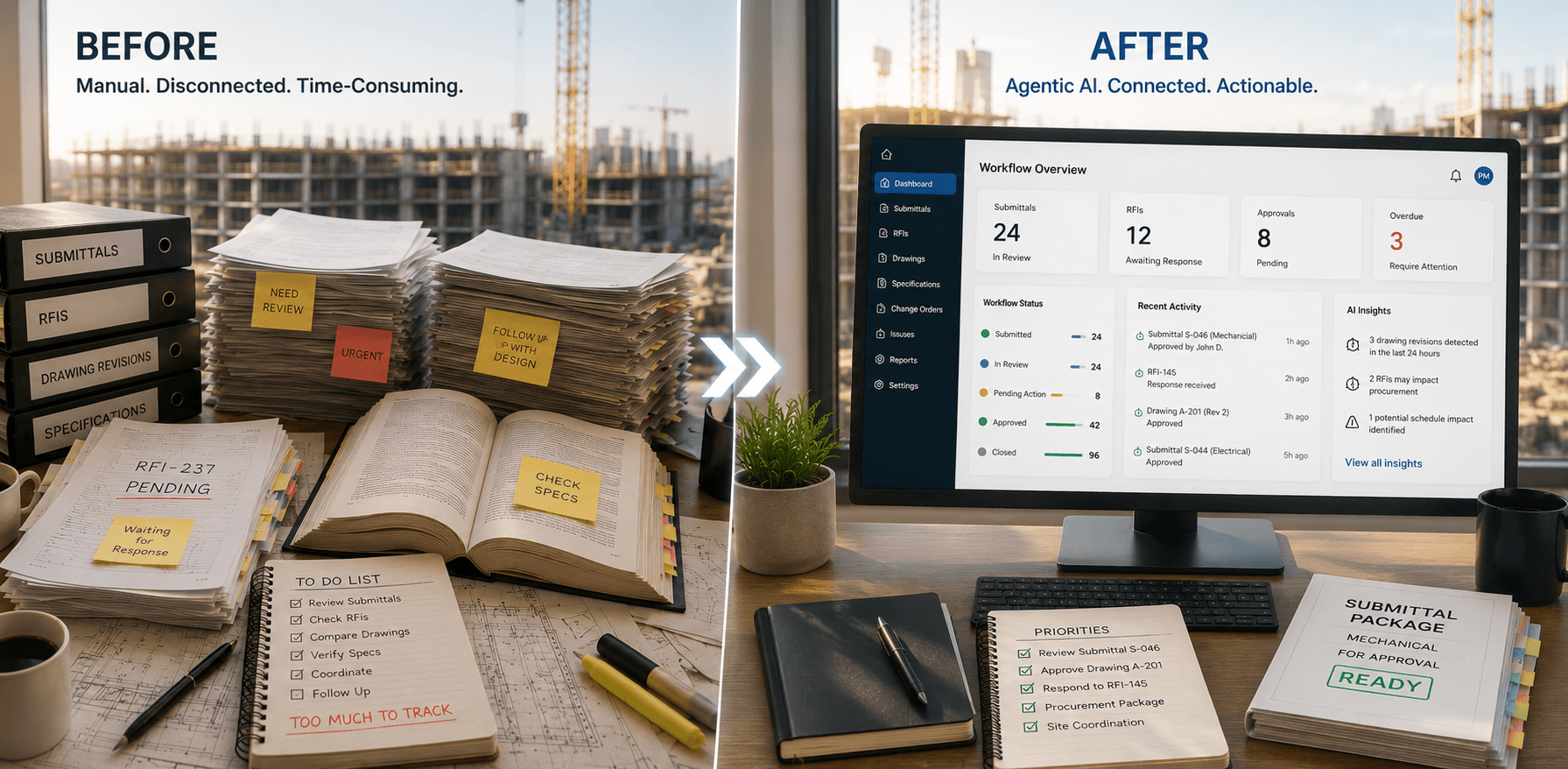
Construction projects rarely fail because of execution alone. They fail because the right information didn't reach the right person in time. And by the time it did, the window to act had already closed.
As projects scale, the problem compounds. More stakeholders, more dependencies, more documents moving through systems that still rely on teams to manually organize and interpret information before anything can move forward. The work waits on the process. And the process hasn't kept pace with the complexity it's being asked to manage.
Manual workflows are the silent killers
A large portion of a project manager's time still goes into coordination and document handling — reviewing submittals, checking drawings, tracking changes, and following up on approvals. These tasks are necessary, but they are slow, repetitive, and in most cases, still done manually. This evidently leads to missed details, delayed decisions, and a review process that can't keep pace with project complexity.
Some industry reports suggest construction professionals spend a significant share of their week on non-productive activities — searching for project information, resolving conflicts, and fixing mistakes. One frequently cited figure puts that at over 14 hours a week, though this likely varies by project type and role.
Furthermore, Oracle confirms that construction remains one of the least digitized industries, with many workflows still dependent on manual processes and disconnected systems. That fragmentation slows the project down.
Reviewing submittals and drawings on large projects can consume tens of hours per package — time spent manually cross-checking against specifications where inconsistencies are most likely to go undetected.
The downstream costs are substantial. Delayed approvals stall procurement, and when materials aren't on-site when crews are ready, productivity losses follow: crews wait, get reassigned, and schedules slip. Deficiencies that should have been resolved during review instead surface in the field, where the cost to remediate them is significantly higher. Underlying all of this is a more persistent structural problem — construction decisions are routinely made on incomplete or delayed information, and that remains one of the industry's most stubborn sources of inefficiency.
What changes with agentic AI in practice
Construction teams have been adopting software and digital platforms for years, but the volume of documents and the complexity of dependencies on large projects has outpaced what most of those tools were built to handle. That gap is where agentic AI fits.
Using AI tools isn't enough — knowing how to integrate them is where the value is. This is where agentic AI can come into play. Agentic AI is a form of artificial intelligence that operates autonomously, using "agents" to plan, reason, and execute multi-step construction tasks—such as scheduling, safety monitoring, and supply chain logistics—with minimal human intervention. It isn’t just another layer of automation. It changes how work moves.Instead of waiting for someone to open a document and start reviewing, an agentic system can check submittals against specifications as soon as they’re uploaded, flag issues, and keep track of what needs action.
Agentic AI can recommend next steps, create reports, draft communications as per your work processes, recognize patterns using thousands of data points across multiple documents, provide predictive alerts that would appear weeks before they would appear in a manual report and suggest corrective actions, thus saving considerable amount of time and manual work.
The result is straightforward: reviews move faster, fewer iterations are needed, and teams spend more time making decisions instead of chasing information.
How Krixi Core approaches it
Krixi Core applies this approach to submittal and document workflows. It checks submittals against project specifications, highlights gaps, and tracks changes between versions. Instead of starting each review from scratch, teams can focus on what needs attention.
It also tracks ownership and status, so tasks don’t sit unnoticed. If something stalls, it becomes visible early, before it turns into a schedule issue. An AI agent can search across documents and surface answers in minutes instead of the hour it takes to manually dig through a 400-page spec set..On a live project, that means fewer delays caused by missed reviews or unclear ownership. Reviews move faster, issues are identified earlier, and teams spend less time following up.