

A pattern shows up consistently across construction platforms and job-site forums:
“Submittal review is slow even for experienced teams. On a $50M project with 1,250 spec pages, expect 40 hours with software but 60 to 80 without it. On a $300M+ project, that comes down to around 30 hours with automation, but only because experience fills the gaps the software leaves. A rough rule of thumb: 600 spec pages takes a seasoned professional two to three days, usually while managing everything else on the project.
In another conversation, a project manager said:
“The submittal process still requires a significant amount of manual review, largely due to limitations in how current tools are implemented and managed. Some submittals involve multiple phases, but the system does not always accommodate that complexity effectively, requiring additional planning and foresight.
That's not a war story. That's a normal Tuesday afternoon.
What delayed submittal reviews actually cost
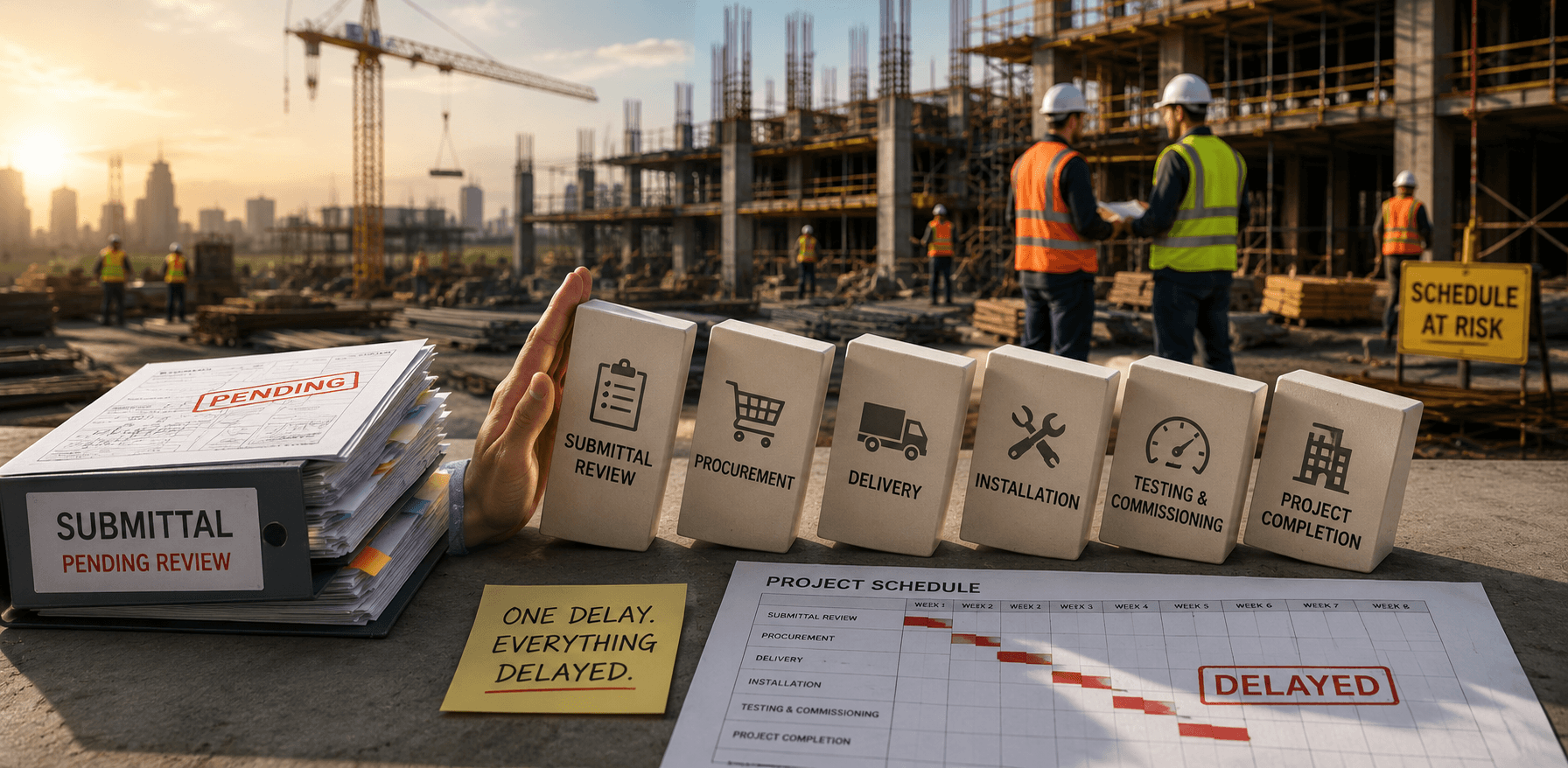
A delayed submittal doesn't stall just that item — it stalls everything scheduled around it.
Let’s take an example on a typical MEP-heavy project where 200 to 300 submittals need review and approval. These approvals don't move independently and rely heavily on submittal review. The switchgear waits on the transformer or the ductwork waits on the air handlers. Thus, one delayed approval has the potential to push everything downstream that was counting on it.
McKinsey's research on construction productivity found that major projects are delivered, on average, a full year behind schedule. The seed of that delay is almost always planted in the first three months, caused by the slow review process that never quite catches up.
The financial consequences follow directly. Procurement can't begin without approved submittals. Field crews mobilize based on planned schedules, when equipment delivery shifts, those crews either stand idle or get reassigned, creating coordination problems that surface later as rework.
Every week of schedule delay extends general conditions, compounds supervision costs, and can trigger subcontractor change orders. The 2024 AGC Hiring and Business Outlook Survey found that 43% of contractors already struggle to find time to implement new processes — and that's before a backlogged review queue starts compressing everything else. The process hasn't changed much in decades but the volume has increased significantly.
Ultimately, the pressure lands on the project manager. Every hour spent at a desk working through cut sheets is an hour not spent on site. In the first week of mobilization, that trade-off feels manageable. By week three, when the queue is growing faster than anyone can clear it, the site is moving without the PM because the PM isn't there. Decisions get made by whoever is available rather than whoever should be making them. Small problems that would have been caught on a site walk become expensive ones that surface during inspection. Not because the team isn't capable — but because the person whose job is to stay ahead of problems is buried in a review queue instead of walking the job.
That's the real cost of a broken submittal process.
How AI Changes the Review Process
That comparison work — spec open, cut sheet open, requirement by requirement — is what AI handles. The manual process of opening a spec, opening a cut sheet, checking requirement by requirement across a 70-page document — that's where the time is lost. AI platforms can automate this without replacing the human judgment. What it does is eliminate the comparison work so that project managers are spending time on decisions that move the project forward rather than data extraction that holds it in place.
What used to take a project manager and two engineers the better part of a week now gets done in a day— not because anything is skipped, but because the cross-referencing and page-by-page spec verification happen before anyone opens the file. The PM's time goes into decisions, not data extraction, and on a live project, that difference shows up on the schedule.
How Krixi Core Does It
Krixi Core flags discrepancies and tells you what they mean — what's a compliance issue, what's a coordination risk, what can wait.. The platform compares submittal packages against project specifications automatically, produces an intelligent summary of each review, and calls out exactly what is incomplete, non-compliant, or at risk of creating a downstream problem. The reviewer isn't hunting for issues. They're working through a clear list of action items that already distinguishes what's urgent from what can wait.
The documentation side matters as much as the speed. Every discrepancy flagged, every decision logged, every version change tracked, the submittal record becomes something the teams can rely on if a dispute arises later. Most disputes in construction trace back to what was approved, when, and under what conditions. Getting that right during review is cheaper than reconstructing it at closeout.
If submittal review is where your schedule starts slipping, a walkthrough will usually show exactly where the hours go.